
On the page
- Statutory Text
- Plain English Explanation
- Frequently Asked Questions About NRS 42.005
- What is the difference between punitive damages and compensatory damages in Nevada?
- How much can punitive damages be in Nevada?
- What does "clear and convincing evidence" mean for punitive damages?
- Can an insurance company be ordered to pay punitive damages in Nevada?
- Does the jury know about the punitive damages cap when deciding the amount?
Statutory Text
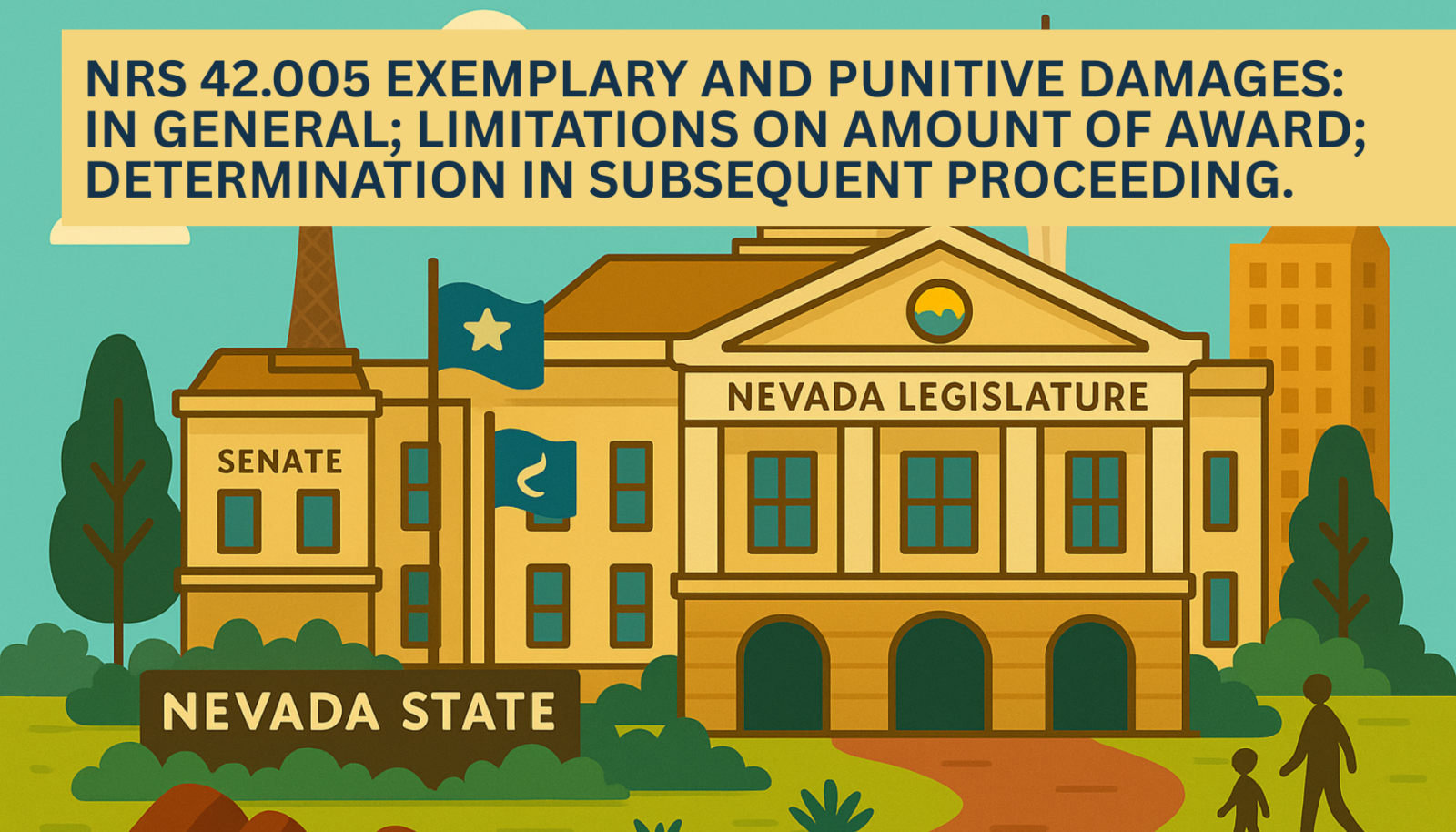
1. Except as otherwise provided in NRS 42.007, in an action for the breach of an obligation not arising from contract, where it is proven by clear and convincing evidence that the defendant has been guilty of oppression, fraud or malice, express or implied, the plaintiff, in addition to the compensatory damages, may recover damages for the sake of example and by way of punishing the defendant. Except as otherwise provided in this section or by specific statute, an award of exemplary or punitive damages made pursuant to this section may not exceed:
(a) Three times the amount of compensatory damages awarded to the plaintiff if the amount of compensatory damages is $100,000 or more; or
(b) Three hundred thousand dollars if the amount of compensatory damages awarded to the plaintiff is less than $100,000.
2. The limitations on the amount of an award of exemplary or punitive damages prescribed in subsection 1 do not apply to an action brought against:
(a) A manufacturer, distributor or seller of a defective product;
(b) An insurer who acts in bad faith regarding its obligations to provide insurance coverage;
(c) A person for violating a state or federal law prohibiting discriminatory housing practices, if the law provides for a remedy of exemplary or punitive damages in excess of the limitations prescribed in subsection 1;
(d) A person for damages or an injury caused by the emission, disposal or spilling of a toxic, radioactive or hazardous material or waste; or
(e) A person for defamation.
3. If punitive damages are claimed pursuant to this section, the trier of fact shall make a finding of whether such damages will be assessed. If such damages are to be assessed, a subsequent proceeding must be conducted before the same trier of fact to determine the amount of such damages to be assessed. The trier of fact shall make a finding of the amount to be assessed according to the provisions of this section. The findings required by this section, if made by a jury, must be made by special verdict along with any other required findings. The jury must not be instructed, or otherwise advised, of the limitations on the amount of an award of punitive damages prescribed in subsection 1.
4. Evidence of the financial condition of the defendant is not admissible for the purpose of determining the amount of punitive damages to be assessed until the commencement of the subsequent proceeding to determine the amount of exemplary or punitive damages to be assessed.
5. For the purposes of an action brought against an insurer who acts in bad faith regarding its obligations to provide insurance coverage, the definitions set forth in NRS 42.001 are not applicable and the corresponding provisions of the common law apply.
(Added to NRS by 1989, 486; A 1995, 2669)
NV Rev Stat § 42.005 – Last Verified February 2026
Plain English Explanation
When someone hurts you in a way that goes beyond a simple accident, Nevada law gives courts the power to do more than just make you “whole” financially. Punitive damages, sometimes called exemplary damages, are extra money a court can order a wrongdoer to pay on top of your regular compensation. The purpose is to punish truly bad behavior and send a message to others.
To win punitive damages in Nevada, you have to prove something more serious than ordinary negligence. The person who hurt you must have acted with oppression, fraud, or malice. That is a high bar. The law requires “clear and convincing evidence,” which is a stronger standard than what is typically needed in civil cases.
How Much Can You Actually Get?
Nevada puts a cap on punitive damages in most situations. If your compensatory damages (the actual losses you suffered) are $100,000 or more, punitive damages cannot exceed three times that amount. If your compensatory damages are less than $100,000, the punitive award is capped at $300,000. So the more serious your underlying harm, the higher the potential punishment for the wrongdoer.
These caps are not universal, though. Several types of cases are completely exempt from those limits. If you were harmed by a defective product, you were the victim of housing discrimination, you were injured by toxic or hazardous waste, or you are suing for defamation, the cap does not apply. Insurance companies that act in bad faith toward their policyholders also fall outside the cap.
How the Process Works in Court
The trial is actually split into two parts when punitive damages are involved. First, the jury decides whether punitive damages are even appropriate. If they say yes, a second proceeding takes place where the same jury determines the dollar amount. Importantly, the jury is never told about the caps during this process. That way, jurors are not influenced by the limits when they are deciding what kind of behavior deserves punishment.
One more notable rule: the defendant’s financial condition and wealth cannot be brought up until that second phase of the trial begins. This keeps the focus of the initial decision on the wrongdoing itself rather than on how much money the defendant has.
Frequently Asked Questions About NRS 42.005
What is the difference between punitive damages and compensatory damages in Nevada?
Compensatory damages are meant to cover your actual losses, things like medical bills, lost wages, or property damage. Punitive damages go beyond that. They are extra money awarded not to repay you for a loss, but to punish a defendant who acted with malice, fraud, or oppression. Think of compensatory damages as making you whole and punitive damages as holding the wrongdoer accountable for especially bad behavior.
How much can punitive damages be in Nevada?
In most cases, Nevada caps punitive damages at three times your compensatory damages if those damages reach $100,000 or more. If your compensatory damages are under $100,000, the maximum punitive award is $300,000. However, certain cases like defamation, toxic waste injuries, defective product claims, and insurance bad faith claims are not subject to these limits.
What does “clear and convincing evidence” mean for punitive damages?
Clear and convincing evidence is a higher legal standard than the usual “preponderance of the evidence” used in most civil cases. It means you have to show the court that it is highly probable, not just more likely than not, that the defendant acted with malice, fraud, or oppression. It is a meaningful hurdle that prevents punitive damages from being awarded in ordinary negligence cases.
Can an insurance company be ordered to pay punitive damages in Nevada?
Yes. If an insurance company acts in bad faith by wrongfully denying coverage or failing to honor its obligations to a policyholder, it can face punitive damages. Notably, insurers acting in bad faith are not protected by the standard caps, meaning a jury could award an amount beyond the usual limits. The common law definition of bad faith applies in these cases rather than the definitions found elsewhere in the statute.
Does the jury know about the punitive damages cap when deciding the amount?
No. Nevada law specifically prohibits the jury from being told about the caps on punitive damages while they are deciding how much to award. The idea is that jurors should focus on the severity of the defendant’s conduct rather than working backward from a legal limit. The judge applies any applicable cap after the jury delivers its verdict.
If you believe you have a case involving malice, fraud, or oppression and want to explore whether punitive damages could apply to your situation, the experienced team at Get The Win Injury Lawyers is ready to fight for every dollar you deserve. Reach out today for a free consultation and let them put their knowledge of Nevada law to work for you.

We are more than just a personal injury firm. Our team of experienced trial lawyers focuses on complex catastrophic injury and wrongful death cases. These matters require a higher level of skill and dedication than ordinary personal injury claims, and not every law firm is equipped to handle them.
Related Posts


May 19 2025 NRS 11.190 Periods of limitation.




Sep 23 2024 Nevada bus accident lawsuit process explained
Sep 23 2024 What are the car accident laws in Nevada?

Client Testimonials
We prioritize client satisfaction from the first consultation to the final case resolution. And our Las Vegas personal injury attorneys have earned 5-star client satisfaction, with glowing testimonials from injured clients across Nevada. We prioritize client satisfaction from the first consultation to the final.
Results & track record
Nevada
born and bred
Trusted
and reviewed
99.9%
satisfaction
Proven
trial lawyers
Awards & Associations