Study Shows Left-Lane Campers Impact Traffic Safety Across the U.S.—With Key Insights for Nevada Drivers
Why “Keep Right, Except To Pass” might be just as important as “Slow Down” for preventing fatal crashes
Why “Keep Right, Except To Pass” might be just as important as “Slow Down” for preventing fatal crashes
Picture this: You’re cruising down I-15 through Las Vegas, and traffic ahead starts backing up. As you get closer, you spot the culprit—a car in the far-left lane going 10 mph under the speed limit while faster traffic stacks up behind them. Frustrated drivers start weaving right, cutting back left, tailgating, and making aggressive moves to get around the bottleneck
Sound familiar?
Most Nevada drivers have witnessed this scenario countless times. We see the electronic freeway signs telling us to “Slow Down, Speeding Kills”—and that message is important. But our analysis of nationwide crash data reveals something striking: there’s another traffic safety message that deserves equal attention.
“Keep Right, Except To Pass.”
We analyzed every fatal freeway crash across the United States in 2023, looking for a specific pattern we call the “Left-Lane Conflict Signature” (LLCS). This pattern appears when crashes involve the exact types of risky maneuvers you’d expect to see when faster traffic tries to navigate around slower vehicles camping in the left lane.
Here’s what we found:
Nevada ranked 18th out of 51 states and territories, putting us above the national median for this dangerous pattern.
Rather than trying to prove who was “at fault” in crashes, we looked for telltale signs that left-lane interactions might have played a role. A crash earned our LLCS designation when at least two of these elements appeared together:
🚗 Left-side roadway departure – When vehicles run off the left side of the freeway (often while trying to avoid a collision or during an aggressive maneuver)
🔄 Lane-changing maneuvers – Evidence of passing, merging, avoiding, or changing lanes right before the crash
⚠️ Passing-related driver factors – Police reports noting issues like improper passing, failure to stay in proper lane, or following too closely
Think of it like forensic evidence at a crime scene. We can’t see the “left-lane camping” directly in crash reports, but we can see the signature it leaves behind—a pattern of left-side crashes combined with aggressive maneuvering and passing violations.
When we examined the crashes nationwide that showed this left-lane conflict pattern, here’s the breakdown of what we found:
91.8%
involved vehicles running off the left side of the roadway
85.3%
involved lane-changing or passing maneuvers
29.4%
had driver factors related to improper passing or lane discipline
2.9%
had actual passing violations recorded
That last number is telling—only 2.9% had formal passing violations noted, even though nearly 30% had passing-related driver factors documented. This suggests these dangerous behaviors are significantly under-recorded in official reports.
Here are all the states ranked by the percentage of fatal freeway crashes that showed left-lane conflict signatures:
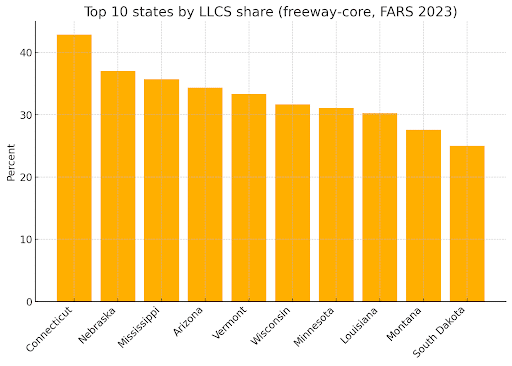
Top 10 states by LLCS share among fatal freeway‑core crashes (FARS 2023).
Top 10 States with Highest Left-Lane Conflict Rates:
Nevada’s Position: 18th place with 14.29% (7 of 49 crashes)
While Nevada didn’t crack the top 10, our rate still puts us above the national median of 11.02%—meaning this is a measurable safety issue on our freeways.
This means Nevada has a bigger problem with left-lane conflicts than most states in America.

Nevada vs U.S. median: share of fatal freeway‑core crashes with the LLCS pattern (FARS 2023).
If you’ve been injured in an accident in Las Vegas or anywhere in Southern Nevada, we’re here to help. Visit our office at 319 S 3rd St Suite 200, Las Vegas, NV 89101, or if you can’t travel due to your injuries, we’ll come to you—at your home, hospital, or wherever is most convenient.
Call us at (702) 867-8900 or contact us through our website to schedule your free consultation. We’ll listen to what happened, explain your legal options in plain language, and answer all your questions. No pressure, no fees unless we win your case.
We serve clients throughout Las Vegas, Henderson, North Las Vegas, Summerlin, and all of Clark County.
We’re not saying slow drivers cause crashes. Let’s be crystal clear about that. Speed still kills, and aggressive driving is dangerous regardless of the circumstances.
What we are saying is that the interaction between different driving speeds creates risks—especially when slower traffic occupies the left lane while faster traffic tries to navigate around them.
Here’s the real-world translation: when someone camps in the left lane going slower than traffic flow, it forces other drivers to make riskier moves. They pass on the right, make tight lane changes, tailgate, or brake suddenly. These maneuvers increase the chances of crashes—and when crashes happen at freeway speeds, they’re more likely to be fatal.

We developed a conservative approach to identifying potential left-lane conflicts. A crash only got flagged if multiple warning signs appeared together in the same incident—not just one indicator that might be coincidental.
The Left-Lane Conflict Signature (LLCS) required at least two of these factors to appear in the same crash:
Passing-related driver factor: Police notation of improper passing, improper lane usage, failure to keep proper lane, following too closely, or failure to yield to overtaking vehicle
We also noted passing/lane violations (like “Pass on Right” or “Lane Violations”) when they appeared, but these weren’t required to set the LLCS flag since they’re often under-recorded compared to driver factor notes.
✅ Reduces overall crash risk
✅ Decreases injury severity
✅ Well-established and important message
✅ Reduces speed differentials
✅ Minimizes risky passing maneuvers
✅ Improves traffic flow
✅ Addresses a measurable crash pattern affecting 10.77% of fatal freeway crashes

No. We’re not assigning fault or blame to any group of drivers. The pattern shows that interactions around the left lane—involving maneuvering, passing, and lane changes—appear in a measurable share of fatal freeway crashes (10.77% nationally, 14.29% in Nevada). Both slower and faster drivers contribute to these situations.
Absolutely not. Speed still increases both crash risk and injury severity. Our point is that speed differentials and lane discipline matter alongside absolute speed. The safest roads have both appropriate speeds AND proper lane usage.
Police officers often note driver factors (like “improper passing”) more frequently than they cite specific violations (like “pass on right”). This is common in crash investigations where officers focus on documenting what happened rather than issuing citations to deceased or seriously injured drivers. The 29.4% driver factor rate versus 2.9% violation rate shows this documentation gap.
FARS provides the most comprehensive, consistent national database available for crash analysis. We acknowledge this as a limitation—the patterns might look different if we could analyze all crashes, including minor ones. However, fatal crashes represent the most serious safety outcomes we want to prevent.
FARS excludes non-fatal and property-damage-only events; shares may differ in the full crash universe
Left-lane “camping” is behavioral and not directly coded. We rely on a conservative co-occurrence proxy (left-run-off + lane-change/passing cues + passing/lane driver factors)
Posted speed information wasn’t consistently available across all crash reports in our dataset
Our findings reflect relationships within fatal freeway crashes, not definitive proof about any single driver’s behavior
Nevada’s freeways see a measurable number of fatal crashes (14.29% of all fatal freeway crashes) that bear the signature of left-lane conflicts. While we can’t eliminate all traffic risks, we can address this specific pattern through better messaging, enforcement, and driver education.
The solution isn’t choosing between speed management and lane discipline—it’s doing both. Keep the “Slow Down” campaigns, but add clear guidance about proper lane usage. When traffic flows more predictably, with faster vehicles able to pass efficiently and slower traffic staying right, everyone benefits from reduced conflicts and improved safety.
Remember: The left lane is for passing, not cruising. When you’re done passing, move right. It’s not just courteous—according to our data, it might save lives.
For attorneys, researchers, and others who want the full technical details
When we looked inside the 687 crashes nationwide that met our LLCS criteria, here’s how frequently each component appeared:
Data source: NHTSA Fatality Analysis Reporting System (FARS), 2023
Analysis conducted by: Get The Win Injury Lawyers, Las Vegas Personal Injury Attorneys
For media inquiries: (702) 867-8900 or info@getthewin.com
Legal consultation regarding traffic collision cases: Contact us at (702) 867-8900 or info@getthewin.com
Study Shows Left-Lane Campers Impact Traffic Safety Across the U.S.—With Key Insights for Nevada Drivers | Get The Win Injury Lawyers, Las Vegas
Nevada
born and bred
Trusted
and reviewed
99.9%
satisfaction
Proven
trial lawyers










 319 S 3rd St Suite 200, Las Vegas, NV 89101
 (702) 867-8900