
On the page
- Why Casino and Hotel Falls Are Different in Las Vegas
- The Legal Foundation: Hotel Premises Liability in Nevada
- Slip and Fall Proof of Negligence: The Four Elements
- Actual vs. Constructive Notice: The Heart of Every Case
- Evidence That Wins a Casino Slip and Fall in Las Vegas
- Who Is Liable If You Fall at a Hotel on the Strip?
- Comparative Fault and the “Open and Obvious” Myth
- Deadlines: How Long Do You Have to File?
- What If You Signed a Waiver Before Entering the Property?
- Compensation You Can Recover
- How Get The Win Injury Lawyers Prove Negligence for You
- Speak With a Las Vegas Slip and Fall Lawyer
- Frequently Asked Questions
Las Vegas welcomed roughly 38.5 million visitors in 2025, and most of them spent their time walking across the polished marble, tile, and granite floors of the city’s casinos and resort hotels. Those floors are constantly exposed to spilled cocktails, tracked-in rain, leaking ice machines, freshly mopped surfaces, and round-the-clock foot traffic. When a property fails to control those hazards, the result is a slip and fall accident that can leave a visitor with a broken hip, a concussion, or a spinal injury that changes their life.
Winning one of these cases is not about proving you fell — the property already knows that. It comes down to one thing: proving the casino or hotel was negligent. This guide explains how negligence is established under Nevada law, why a casino slip and fall in Las Vegas is different from an ordinary fall, and what evidence wins.
Why Casino and Hotel Falls Are Different in Las Vegas

A slip and fall accident inside a major Las Vegas resort has unique features that work in an injured guest’s favor — if the evidence is preserved quickly. Unlike a fall at a small store, Strip and Downtown properties run sophisticated systems that create a paper trail of negligence:
- Comprehensive surveillance. Casinos film nearly every square foot for gaming compliance — footage frequently captures both the hazard and the fall itself.
- Documented inspection duties. Resorts keep written housekeeping, sweep, and maintenance logs. Gaps in those logs are powerful evidence no one was checking the floor.
- High-risk conditions. Polished flooring, 24-hour alcohol service, dim lighting, and constant beverage traffic make spills foreseeable — not freak accidents.
- Deep-pocket defendants. Operators carry large liability policies and hire aggressive defense firms whose job is to shift blame onto you.
The same systems that prove negligence are controlled by the property — which is why involving an experienced Las Vegas slip and fall lawyer immediately is critical.
The Legal Foundation: Hotel Premises Liability in Nevada
Every hotel premises liability claim in Nevada begins with one principle: a property owner has a legal duty to keep the premises reasonably safe for the people it invites in. This duty lives in NRS 41.130, and Nevada courts analyze these claims through negligence, reasonableness, foreseeability, and causation (Turner v. Mandalay Sports Entertainment, LLC, 124 Nev. 213 (2008)).
Casino and hotel guests are “invitees” — the highest level of protection under Nevada law. Because you enter for the business’s commercial benefit, the operator must do more than fix hazards it happens to notice. It must actively inspect for dangerous conditions and either correct them or warn you. When it ignores that duty and you are hurt, it owes you compensation.
Slip and Fall Proof of Negligence: The Four Elements
To win, your attorney must establish four legal elements. Together they form the slip and fall proof of negligence every Nevada premises case requires:
- Duty. The casino or hotel owed you reasonable care. For invitees this is rarely disputed — it attaches the moment you lawfully enter.
- Breach. The property failed that duty — an unaddressed spill, no inspection, no warning of a known hazard. This is where cases are won or lost.
- Causation. The breach directly caused your fall and injuries — the hazard, not some unrelated cause, put you on the ground.
- Damages. You suffered real, documented harm: medical bills, lost income, pain and suffering, and other losses.
Element two — breach — is almost always the battleground. And proving breach usually turns on one question: did the property know, or should it have known, about the hazard?
Actual vs. Constructive Notice: The Heart of Every Case
A casino is not automatically liable just because someone fell. You must show it had notice of the dangerous condition. Nevada recognizes two forms, and either one establishes liability:
| Type of Notice | What It Means | Example Evidence |
|---|---|---|
| Actual notice | An owner or employee directly knew about the hazard and failed to act. | A guest reported a spill; a worker saw a leaking ice machine; a prior incident report. |
| Constructive notice | The hazard existed long enough that a reasonable property should have found and fixed it. | Time-stamped video; gaps in sweep logs; a stain showing the spill sat for 30+ minutes. |
Nevada’s leading authority is Sprague v. Lucky Stores, Inc., 109 Nev. 247 (1993), holding that whether a business had constructive notice is a question of fact for the jury — decided by how long the hazard existed and how regular the property’s inspections were. A casino cannot escape liability simply by claiming it never noticed the danger.
Practice tip: The longer a spill sat unaddressed, the stronger your case. That is exactly why sweep logs, inspection schedules, and time-stamped video are the evidence insurers fight hardest to keep from you.
Evidence That Wins a Casino Slip and Fall in Las Vegas
Proving negligence is an evidence game, and in a casino slip and fall in Las Vegas the most important evidence is also the most perishable:
- Surveillance footage — often the single strongest item; casinos overwrite it within 24–72 hours, so a preservation letter must go out immediately.
- The written incident report — insist one is created before you leave and get a copy; refusal to document it is itself evidence.
- Photos of the hazard — before cleanup, capture the spill or defect and the absence of warning signs.
- Sweep, inspection & maintenance logs — gaps on the day of your fall directly support constructive notice.
- Prior complaints & incident history — earlier falls at the same spot prove the danger was known and recurring.
- Witness details & same-day medical records — these tie the conditions and your injuries to the fall.
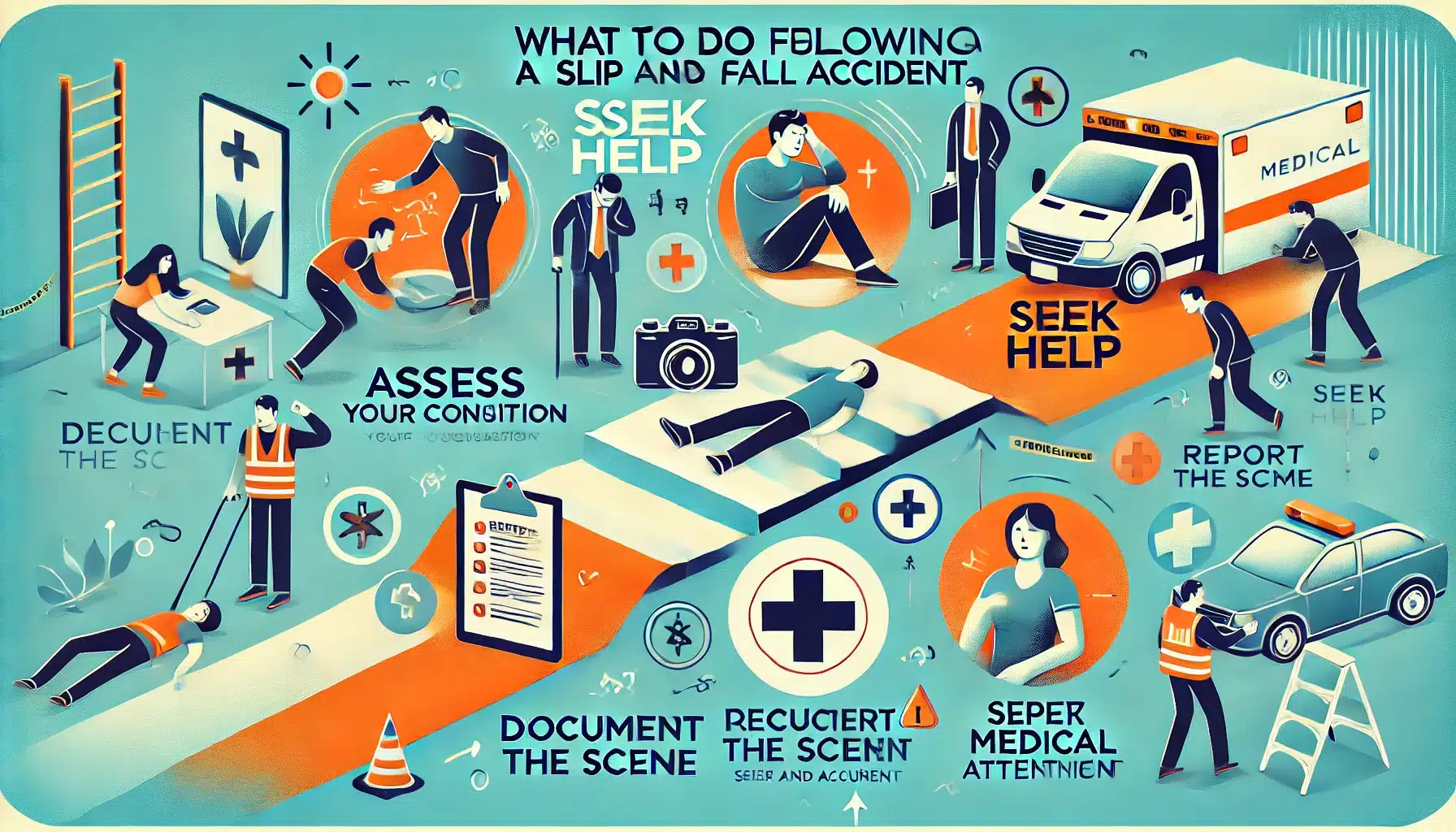
For a step-by-step scene checklist, see our guide on what to do after a slip and fall accident.
Who Is Liable If You Fall at a Hotel on the Strip?
 Liability rests with whoever owned or controlled the area where you fell and failed to keep it safe. In a sprawling resort that is often more than one party, and a thorough investigation finds them all:
- The casino or hotel operator running the gaming floor, lobby, and guest areas.
- The property owner or real-estate entity, frequently separate from the operating company.
- A third-party janitorial or maintenance contractor responsible for floor care.
- A restaurant, nightclub, bar, or retail tenant leasing space where the fall occurred.
- A government entity, if you fell on adjacent public property — which carries different rules (below).
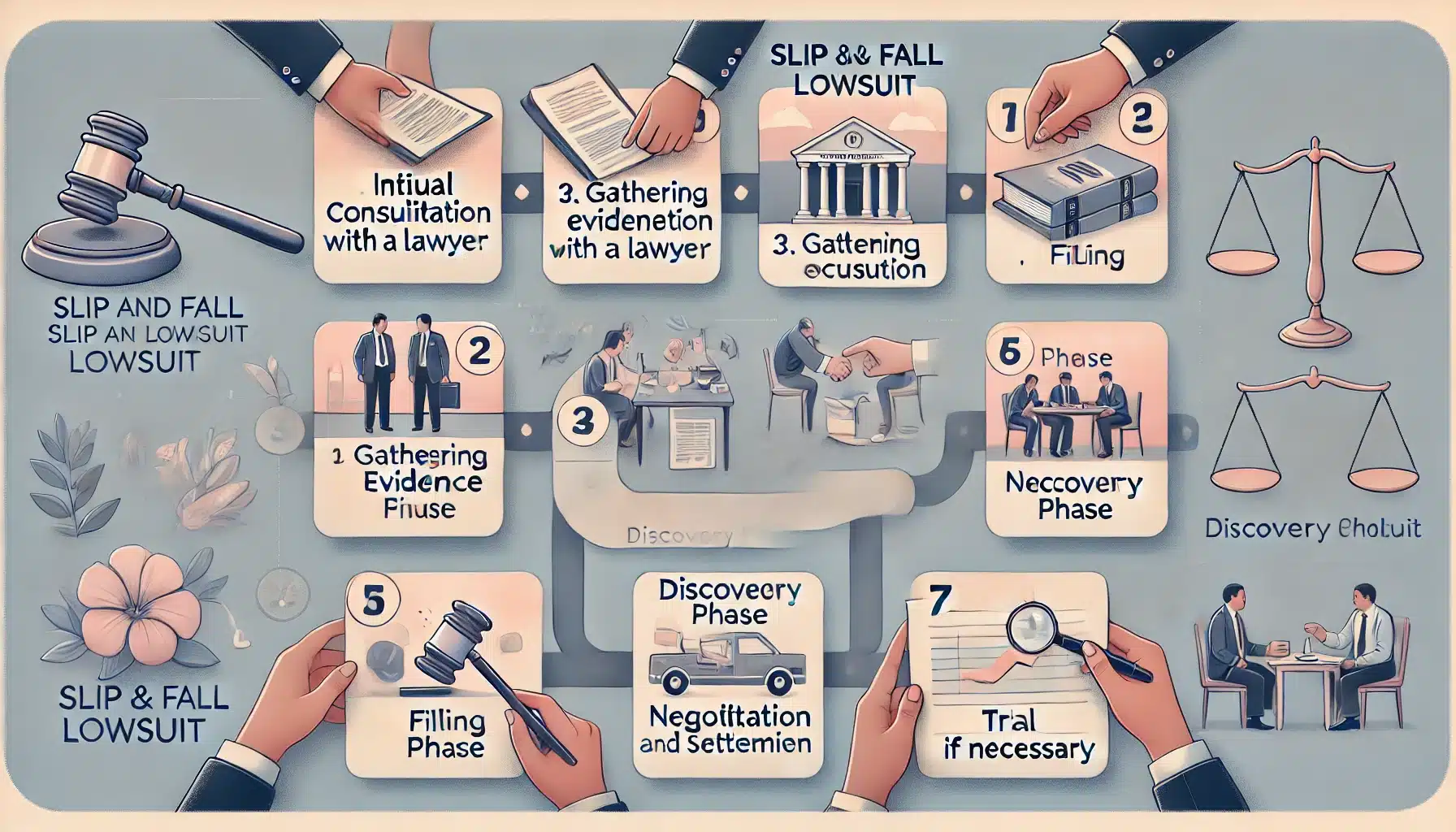
Identifying every liable defendant is one of the most valuable steps in the Nevada slip and fall lawsuit process.
Comparative Fault and the “Open and Obvious” Myth
The property’s favorite defense is to blame you. Under Nevada’s modified comparative negligence rule, NRS 41.141, your compensation is reduced by your share of fault — and at 51% or more you recover nothing.
Example: If your damages are $150,000 and a jury assigns you 20% of the fault, you recover $120,000. The defense’s whole goal is to push that share past the halfway mark — countering it with evidence is essential.
Casinos also lean on the “open and obvious” argument — that the hazard was so visible you should have avoided it. Nevada law rejects that as an automatic excuse. In Foster v. Costco Wholesale Corp., 128 Nev. 773 (2012), the Nevada Supreme Court held a landowner is not automatically relieved of reasonable care just because a danger was open and obvious. Casino noise, crowds, and alcohol service are all factors a jury may weigh.
Deadlines: How Long Do You Have to File?
Under NRS 11.190, you generally have two years from the date of your fall to file. Different situations carry different rules:
| Your Situation | Deadline to Act | Governing Law |
|---|---|---|
| Fall at a private casino or hotel | 2 years from the fall | NRS 11.190(4)(e) |
| Fall on government property | 2-year claim; $200K cap; no punitive | NRS 41.036 / 41.035 |
| Injured minor | Paused until age 18 | NRS 11.190 |
| Preserving surveillance video | 24–72 hours — act now | Property retention policy |
Important: the legal deadline is not the practical deadline. Surveillance video disappears in days, not years. To preserve the evidence that proves negligence, the time to act is immediately.
What If You Signed a Waiver Before Entering the Property?
First, a key point: walking into a casino or checking into a hotel almost never involves a liability waiver. Waivers usually appear with on-site activities — a zipline, pool cabana, nightclub event, gym, or spa. If you did sign one, it is not the end of your claim.
Under Nevada law, a waiver can only release a business from ordinary negligence. It cannot shield gross negligence, recklessness, or intentional misconduct, and courts will not enforce a waiver buried in fine print or contrary to public policy. A waiver signed by a minor is unenforceable, and a parent cannot sign away a child’s right to sue.
So if a resort ignored a known, deteriorating hazard — the kind of blatant disregard that rises to gross negligence — a signed waiver may not protect it at all. Each waiver must be read against the specific facts, exactly the analysis a lawyer performs in a free consultation.
Compensation You Can Recover
A successful Nevada premises claim can recover several categories of damages, depending on the severity of your injuries and the strength of the evidence:
| Damages You Can Recover | What It Covers |
|---|---|
| Medical expenses | ER care, surgery, hospitalization, therapy, and documented future treatment. |
| Lost wages & earning capacity | Income lost during recovery and any permanent reduction in your ability to work. |
| Pain & suffering | Physical pain and emotional toll; Nevada does not cap these in ordinary injury cases. |
| Out-of-pocket costs | Transportation, home modifications, and hired help for tasks you can no longer do. |
| Punitive damages | Available under NRS 42.005 where the property acted with deliberate disregard for safety. |
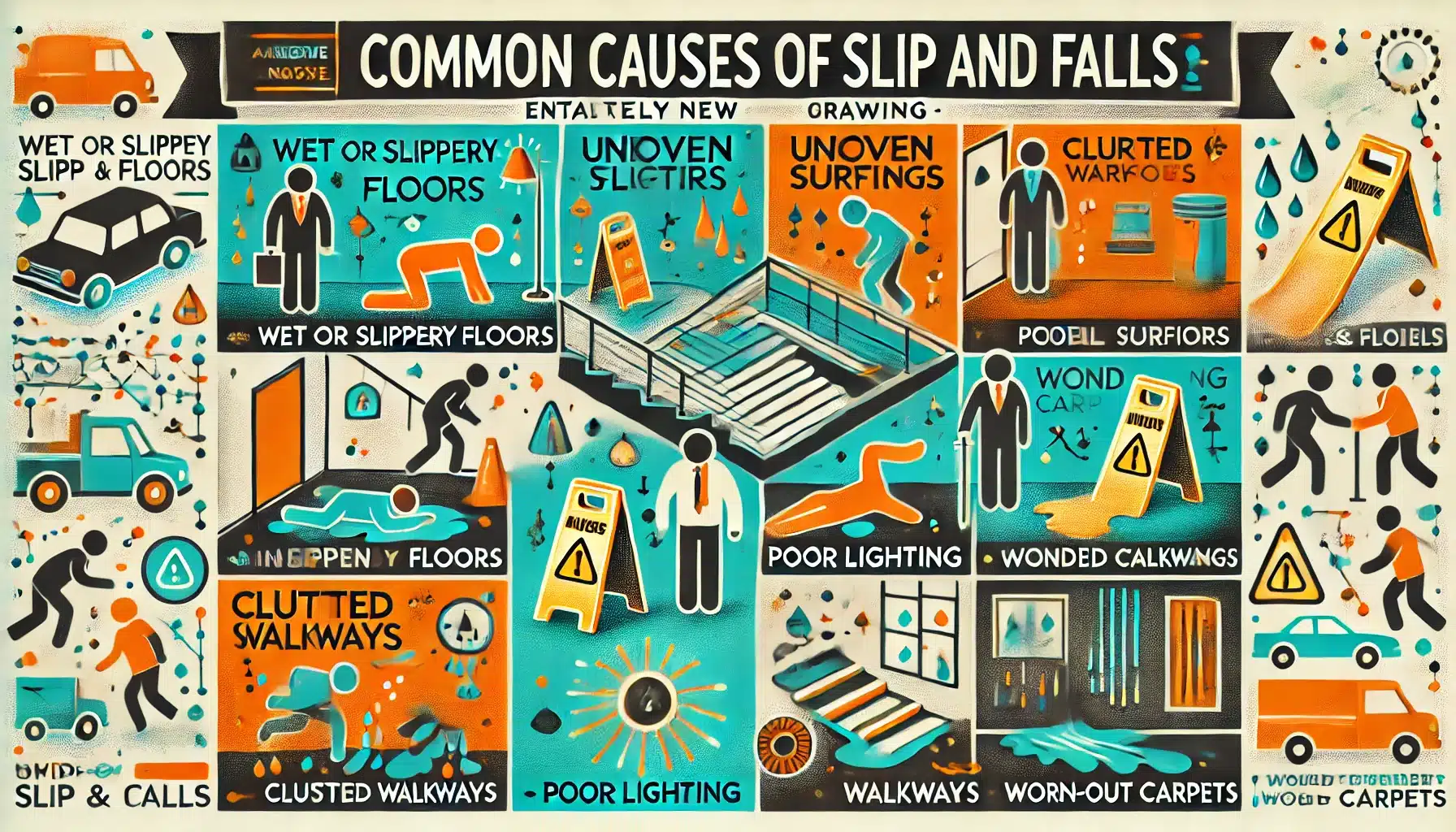
These falls cause serious, expensive injuries — traumatic brain injuries, hip fractures, spinal damage, torn knee ligaments. Learn more about the slip and fall injuries we handle and the common causes of these accidents.
How Get The Win Injury Lawyers Prove Negligence for You
Building a slip and fall proof of negligence against a major Strip property takes speed, local knowledge, and resources. From the moment you hire us, our team:
- Sends evidence-preservation letters the same day to stop footage from being overwritten;
- Secures incident reports, sweep logs, inspection schedules, and prior-complaint history;
- Identifies every liable party — operator, owner, and contractors;
- Works with your physicians to document current and future medical needs;
- Counters the insurer’s comparative-fault tactics with hard evidence; and
- Takes the case to trial in Clark County District Court if the insurer won’t pay what you’re owed.
Speak With a Las Vegas Slip and Fall Lawyer
We represent slip and fall victims across Clark County on a contingency fee basis — you pay nothing unless we win. If your injuries prevent you from traveling, we come to you. Call (702) 867-8900 for a free, 24/7 consultation, or request your free consultation online. Get The Win Injury Lawyers, 319 S 3rd St, Suite 200, Las Vegas, NV 89101.
Frequently Asked Questions
Can I sue a Las Vegas casino for a slip and fall?
Yes. Casino operators are among the most common defendants in Las Vegas slip and fall cases. As an invitee, you are owed the highest duty of care under NRS 41.130, which means the casino must actively inspect for hazards — not simply respond to ones it happens to notice. When it fails to do so and you are injured, you can pursue a claim. Because casinos film nearly their entire floor, surveillance footage of the hazard and your fall is often the strongest evidence, but it is frequently erased within 24 to 72 hours, so it is essential to call an attorney the same day.
Who is liable if I fall at a hotel on the Strip?
Liability rests with whoever owned or controlled the area where you fell and failed to keep it safe. On the Strip that may be the hotel operator, a separate property-owning entity, a third-party janitorial or maintenance contractor, or a restaurant, bar, or nightclub tenant leasing space inside the resort. More than one party can share responsibility. An attorney identifies every liable defendant during the investigation so no responsible party is overlooked and full coverage is available for your damages.
What evidence do I need to prove negligence in a slip and fall?
The four strongest pieces of evidence are time-stamped surveillance footage, a written incident report created at the scene, photographs of the hazard taken before it is cleaned up, and medical records from the day of your fall. Supporting evidence includes sweep and inspection logs (gaps support constructive notice), prior complaints or incidents at the same spot, witness contact information, and expert testimony on safety standards. The most time-sensitive item is surveillance video, which casinos and hotels routinely overwrite within 24 to 72 hours — so preservation letters must go out immediately.
How long do I have to file a claim after a casino fall?
Under NRS 11.190, you generally have two years from the date of your fall to file a personal injury lawsuit in Nevada. There are important exceptions: if your fall occurred on government-owned property, the Nevada Tort Claims Act applies — a claim must generally be filed within two years under NRS 41.036, recovery is capped at $200,000 per claimant, and punitive damages are barred. For minors, the deadline generally pauses until they turn 18. Keep in mind that the evidence deadline is far shorter than the legal one — surveillance footage disappears within days, so you should contact a lawyer as soon as possible.
What if I signed a waiver before entering the property?
Entering a casino or checking into a hotel almost never requires a waiver; they typically appear with on-site activities like ziplines, pools, gyms, or nightclub events. Even if you signed one, it is not necessarily the end of your claim. Under Nevada law, a waiver can only release a business from ordinary negligence — it cannot shield gross negligence, recklessness, or intentional misconduct, and courts will not enforce a waiver that is buried in fine print, unclear, or against public policy. Waivers signed by minors are unenforceable. Have an attorney review the document against the specific facts of your fall.

We are more than just a personal injury firm. Our team of experienced trial lawyers focuses on complex catastrophic injury and wrongful death cases. These matters require a higher level of skill and dedication than ordinary personal injury claims, and not every law firm is equipped to handle them.
Related Posts
Sep 23 2024 What to do after a slip and fall accident?

Sep 23 2024 Common causes of bus accidents in Nevada

Sep 23 2024 Common slip and fall injuries in Las Vegas

Sep 23 2024 What are the car accident laws in Nevada?
Sep 23 2024 Nevada bus accident lawsuit process explained

Jun 16 2025 Why Are Slip and Fall Cases Hard to Win?
Results & track record
Nevada
born and bred
Trusted
and reviewed
99.9%
satisfaction
Proven
trial lawyers
Awards & Associations